Why Proper Tree Mulching Is Important for Healthy Trees
Why Proper Tree Mulching Is Important for Healthy Trees
Many homeowners spend time watering, fertilizing, and pruning their trees, but one of the simplest and most beneficial tree care practices is often overlooked. Proper mulching can significantly improve the health, longevity, and appearance of your trees while reducing maintenance throughout the year.
Unfortunately, not all mulching is beneficial. In fact, improper mulching techniques can cause serious damage that may eventually lead to disease, pest infestations, or even the death of a tree. One of the most common mistakes professionals see is the creation of "mulch volcanoes," where mulch is piled high against the trunk. Although this has become a common landscaping practice, it can have severe consequences for tree health.
For homeowners in Shelby Township and throughout Michigan, understanding how to mulch trees correctly is an important part of maintaining a healthy landscape. Michigan experiences hot summers, freezing winters, heavy spring rains, and periods of drought, making mulch an important tool for protecting tree roots throughout the year.
This guide explains the benefits of proper mulching, common mistakes to avoid, the best types of mulch to use, and how professional tree care helps trees remain healthy for decades.
What Does Mulch Actually Do?
Mulch is a protective layer of organic or inorganic material placed over the soil surrounding a tree.
While many people think mulch is primarily decorative, its real purpose is to improve growing conditions around the root system.
Proper mulch helps:
- Retain soil moisture
- Moderate soil temperatures
- Reduce weed growth
- Improve soil quality
- Protect roots from lawn equipment
- Reduce soil compaction
- Encourage healthy root development
When applied correctly, mulch creates an environment that closely resembles the natural forest floor where most tree species evolved.
Why Tree Roots Need Protection
Many homeowners assume tree roots grow deep underground.
In reality, most roots grow surprisingly close to the surface.
Approximately 80 to 90 percent of a tree's absorbing roots are found within the top 12 to 18 inches of soil.
These shallow roots are responsible for absorbing:
- Water
- Oxygen
- Nutrients
Because they remain close to the surface, they are vulnerable to:
- Heat
- Drought
- Freezing temperatures
- Lawn mower damage
- Weed trimmer injuries
- Soil compaction
Mulch acts as a protective blanket over these important roots.
Moisture Retention During Michigan Summers
Michigan summers can include long periods without significant rainfall.
Even mature trees experience drought stress during hot weather.
Mulch slows evaporation from the soil, allowing moisture to remain available much longer after rainfall or watering.
This means:
- Less frequent watering
- Healthier root systems
- Reduced drought stress
- Improved overall tree growth
Young trees benefit especially from consistent soil moisture during their establishment years.
Temperature Regulation Throughout the Year
Mulch serves as natural insulation.
During summer it helps keep soil cooler.
During winter it helps reduce rapid freezing and thawing.
Michigan's fluctuating spring and fall temperatures can be particularly stressful for roots.
Mulch reduces these temperature swings and creates a more stable growing environment.
This stability encourages healthier root development and reduces seasonal stress.
Weed Control Benefits
Grass and weeds compete directly with trees for:
- Water
- Nutrients
- Soil space
Young trees often struggle because surrounding turf absorbs much of the available moisture before tree roots can access it.
A properly mulched area suppresses weed growth while reducing competition.
This allows more resources to remain available for the tree itself.
Improved Soil Quality
Organic mulch gradually decomposes over time.
As it breaks down, it adds organic matter to the soil.
This improves:
- Soil structure
- Drainage
- Moisture retention
- Nutrient availability
- Beneficial microbial activity
Healthy soil supports healthier trees.
Unlike synthetic fertilizers, decomposing mulch improves the soil naturally over many years.
Protection Against Lawn Equipment
One of the most common causes of tree decline is repeated trunk damage from lawn equipment.
Every summer, countless trees suffer injuries from:
- Lawn mowers
- String trimmers
- Edgers
Even small wounds damage the tree's protective bark.
Repeated injuries create entry points for:
- Insects
- Disease
- Fungal infections
- Internal decay
A mulch ring creates a protective barrier that keeps mowing equipment safely away from the trunk.
What Is a Mulch Volcano?
A mulch volcano occurs when mulch is piled high against the tree trunk.
Many commercial landscapes unfortunately use this method because it creates a neat appearance.
However, this practice causes several problems.
Why Mulch Volcanoes Damage Trees
When mulch is piled directly against the trunk:
Moisture remains trapped against the bark.
This encourages:
- Rot
- Fungal disease
- Insect infestations
- Bark deterioration
The constant moisture prevents the trunk from drying naturally after rainfall.
Over time, decay develops where the trunk meets the soil.
Root Girdling Can Develop
Excess mulch sometimes encourages new roots to grow upward into the mulch rather than outward into the surrounding soil.
These roots may eventually circle the trunk.
These are known as girdling roots.
As they enlarge, they begin squeezing the trunk, restricting water and nutrient movement throughout the tree.
Girdling roots are a common cause of declining mature trees.
How Much Mulch Is Enough?
More mulch is not always better.
Most professionals recommend:
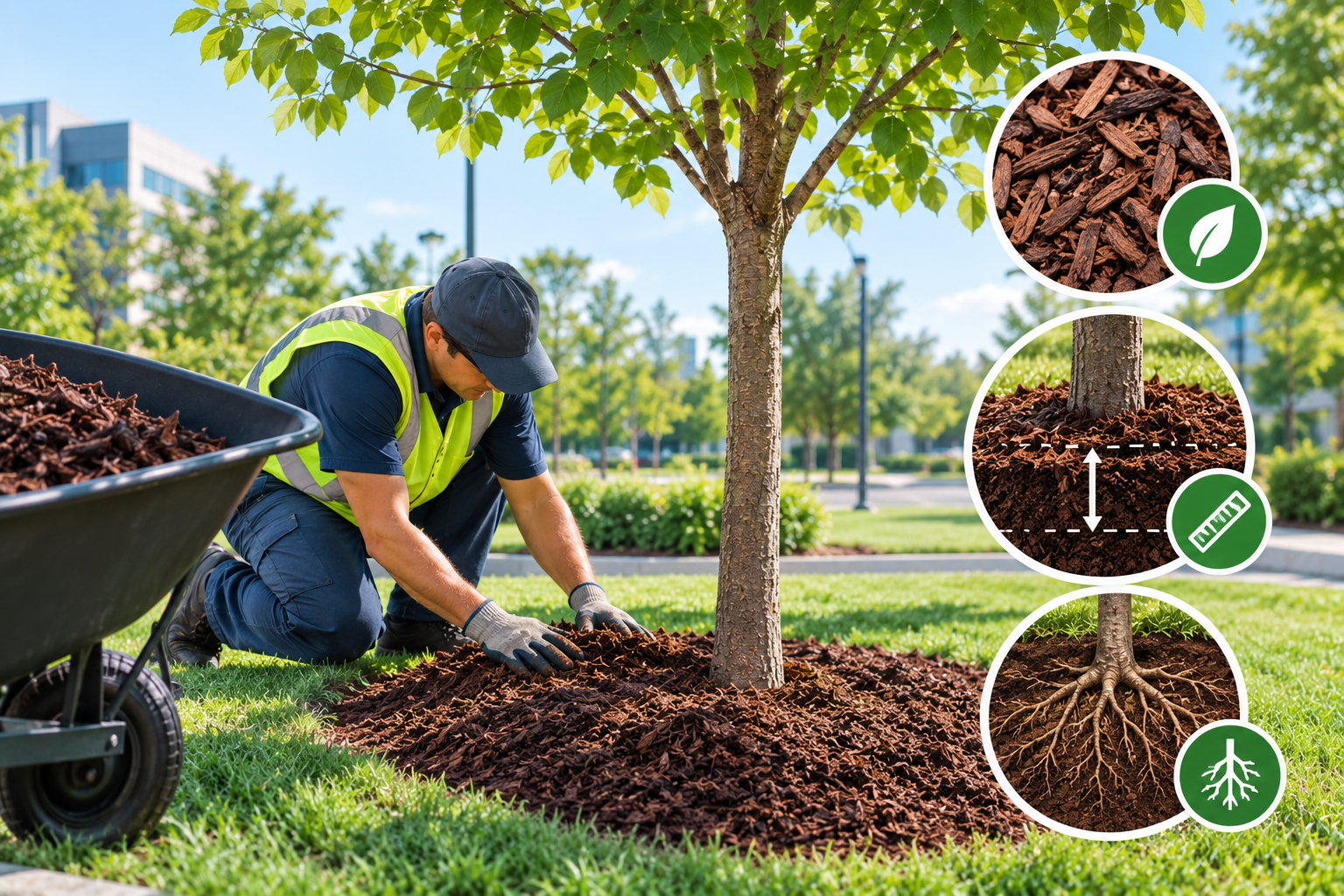
- Two to four inches of mulch depth
Anything deeper than four inches begins limiting oxygen movement into the soil.
Excessively deep mulch may also retain too much moisture, creating ideal conditions for disease.
Keep Mulch Away from the Trunk
The mulch should resemble a wide, flat ring rather than a volcano.
Leave approximately:
- Three to six inches of open space around the trunk.
The root flare should remain visible.
The root flare is where the trunk begins widening at the base before entering the soil.
Keeping this area exposed allows proper airflow and reduces disease risk.
How Wide Should a Mulch Ring Be?
Larger mulch rings provide greater benefits.
Ideally, mulch should extend to the drip line whenever practical.
The drip line represents the outer edge of the canopy.
For most residential properties, mulch rings extending three to six feet from the trunk provide excellent results.
Larger mature trees benefit from even wider mulch areas.
Choosing the Best Mulch
Organic mulch is generally the best choice for trees.
Popular options include:
- Hardwood mulch
- Shredded bark
- Pine bark
- Wood chips
- Leaf mulch
These materials gradually improve soil as they decompose.
Avoid using:
- Dyed mulch containing unknown additives
- Plastic sheeting beneath mulch
- Landscape fabric around mature trees
- Fresh sawdust in thick layers
These materials may restrict oxygen movement or interfere with natural soil processes.
Should Wood Chips Be Used?
Yes.
Wood chips created during professional tree removal make excellent mulch.
Benefits include:
- Slow decomposition
- Excellent moisture retention
- Improved soil quality
- Natural appearance
Many homeowners choose to keep chipped material after tree removal for use throughout their landscape.
Refreshing Mulch Each Year
Mulch naturally decomposes over time.
Most mulch rings should be refreshed annually.
However, avoid simply adding more material every year.
Instead:
- Remove excess buildup if necessary.
- Loosen compacted mulch.
- Restore the proper two to four inch depth.
This prevents mulch volcanoes from gradually developing over time.
Mulching Newly Planted Trees
Newly planted trees benefit tremendously from proper mulching.
During the first several years, mulch helps:
- Retain moisture
- Reduce transplant shock
- Limit weed competition
- Protect fragile roots
- Encourage faster establishment
Young trees that receive proper mulch often establish themselves much faster than trees planted directly into turf grass.
Common Mulching Mistakes
Professional tree companies frequently observe mistakes including:
- Mulch touching the trunk
- Mulch piled too deeply
- Mulching over exposed root flare
- Using rocks instead of organic mulch
- Applying landscape fabric beneath mature trees
- Ignoring mulch maintenance for many years
Correcting these issues can significantly improve tree health.
How Mulching Fits Into Overall Tree Care
Mulching works best when combined with other proper tree care practices.
These include:
- Regular inspections
- Proper pruning
- Disease monitoring
- Watering during drought
- Pest management
- Soil improvement
- Safe tree removal when necessary
Healthy trees result from consistent maintenance rather than any single treatment.
Frequently Asked Questions
Can too much mulch kill a tree?
Yes. Excessive mulch can trap moisture against the trunk, reduce oxygen availability, encourage disease, and promote girdling roots that eventually damage or kill the tree.
How often should mulch be replaced?
Most mulch should be refreshed once each year. Rather than continually adding more material, maintain a total depth of approximately two to four inches.
Is stone mulch good for trees?
Stone may provide decorative value but offers few of the biological benefits of organic mulch. Rocks also absorb and radiate heat, which can increase soil temperatures during summer.
Should grass be removed around trees?
Yes. Removing grass within the mulch ring reduces competition for water and nutrients while minimizing damage from lawn maintenance equipment.
Healthy Trees Begin with Healthy Soil
Proper mulching is one of the simplest and most cost-effective ways to improve tree health. When applied correctly, mulch protects roots, conserves moisture, improves soil quality, and reduces stress throughout Michigan's changing seasons. Just as importantly, avoiding common mistakes such as mulch volcanoes can prevent serious problems that may not become apparent for years.
At Family Tree Removal, we believe that preventative tree care is just as important as tree removal. Helping homeowners maintain healthy trees through proper pruning, inspections, and landscape practices can extend the life of valuable shade trees while reducing future maintenance costs.
We proudly provide professional tree services throughout Shelby Township, Macomb Township, Utica, Sterling Heights, Rochester Hills, Washington Township, and surrounding communities. Our experienced team offers tree removal, tree trimming, stump grinding, lot clearing, emergency tree services, and honest advice to help homeowners make the best decisions for their landscapes.