How to Choose Between Tree Trimming and Tree Removal
How to Choose Between Tree Trimming and Tree Removal
When a tree becomes overgrown, damaged, unhealthy, or too close to your home, one of the first questions you may have is whether it should be trimmed or removed completely. The right answer depends on the condition of the tree, the type of damage present, its location, and the level of risk it creates for your property.
In many situations, professional tree trimming can correct the problem and allow a healthy tree to remain part of your landscape for years. In other cases, trimming only delays an unavoidable removal and may leave a dangerous tree standing near your home, driveway, garage, or neighboring property.
For homeowners in Shelby Township and surrounding Michigan communities, making this decision is especially important because trees face seasonal stress from thunderstorms, high winds, heavy snow, ice, freezing temperatures, and changing soil conditions.
The simplest guideline is this: a healthy tree with manageable branch problems can often be preserved through proper trimming, while a dead, severely damaged, unstable, or extensively decayed tree may need to be removed. A professional assessment can help determine which option makes the most sense.
This guide explains the differences between tree trimming and tree removal, when each service is appropriate, and the warning signs homeowners should never ignore.
What Is Professional Tree Trimming?
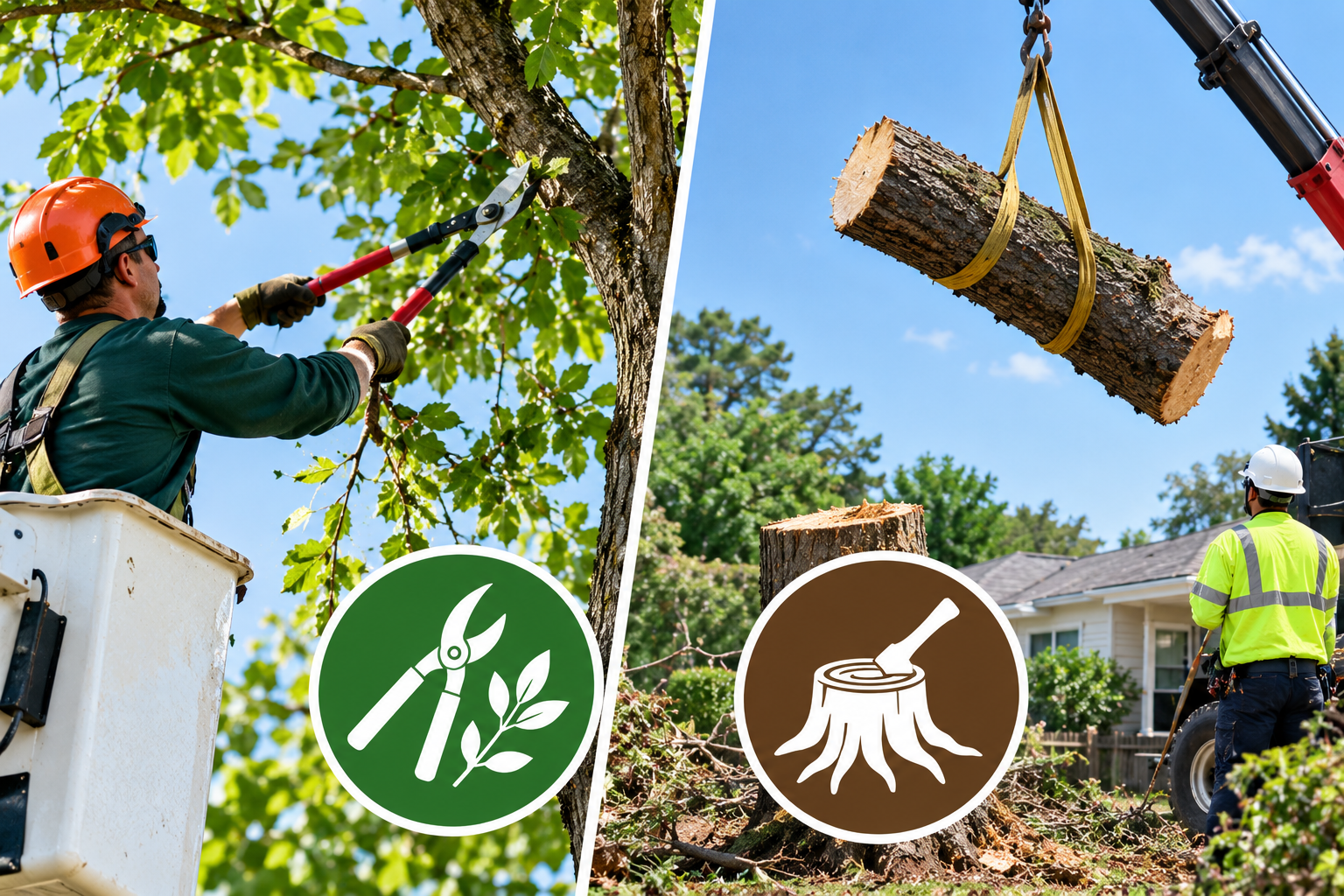
Tree trimming involves selectively removing branches while keeping the tree itself in place.
Professional trimming may be performed to improve safety, encourage healthy growth, provide clearance around structures, or remove damaged portions of a tree.
Common reasons for trimming include:
- Dead branches
- Broken limbs
- Branches rubbing together
- Low branches obstructing driveways or walkways
- Limbs extending toward a roof
- Dense canopy growth
- Storm-damaged branches
- Poor branch structure
When the underlying tree remains healthy and structurally sound, trimming is usually preferable to removal because it allows the homeowner to preserve a valuable part of the landscape.
What Is Tree Removal?
Tree removal involves taking down the entire tree.
Depending on its size and location, a tree may be felled in one piece in an open area or carefully dismantled section by section when it is close to homes, fences, utility lines, landscaping, or other structures.
Removal is generally recommended when preserving the tree creates an unacceptable safety risk or when the tree has declined beyond a reasonable point of recovery.
Common reasons include:
- A dead tree
- Severe internal decay
- Major root failure
- Significant storm damage
- Dangerous leaning
- A split trunk
- Extensive disease
- Construction conflicts
- A tree growing in an unsuitable location
Removal may also be necessary when repeated trimming cannot reasonably solve the underlying problem.
When Tree Trimming Is Usually the Better Option
Healthy trees are valuable assets, so removal should not automatically be the first solution.
If a tree has a strong trunk, healthy roots, and good overall structure, selective trimming can often correct localized problems.
For example, a mature tree may have several dead branches following a harsh Michigan winter while the rest of the canopy remains healthy. Removing those branches may be all that is necessary.
Similarly, a branch growing toward a roof can often be reduced without removing the entire tree.
Proper trimming preserves the benefits of the tree while addressing the immediate concern.
Trimming Can Reduce Storm Risks
One of the primary reasons homeowners request tree trimming is to prepare for severe weather.
Michigan storms can produce strong winds that place considerable pressure on tree canopies.
Trees with excessive deadwood or poorly attached branches may be more likely to lose limbs.
Selective pruning can remove hazardous branches and, when appropriate for the species and condition, improve canopy structure.
However, trimming cannot make every tree safe.
If the trunk or root system is severely compromised, removing branches may do little to address the real problem.
When Dead Branches Do Not Mean the Entire Tree Is Dead
Finding dead limbs does not automatically mean a tree needs removal.
Trees lose individual branches for many reasons, including:
- Storm damage
- Shading
- Drought stress
- Insects
- Previous injuries
- Natural aging
If only a limited portion of the canopy is affected, professional pruning may preserve the tree.
The important question is why the branches died.
If deadwood is caused by a progressive disease or major root decline, additional evaluation may be needed.
When Tree Removal Becomes the Safer Choice
There comes a point when pruning can no longer correct the underlying problem.
A tree should be considered for removal when its structural integrity has deteriorated enough that continued maintenance cannot reasonably reduce the risk.
Several warning signs deserve particular attention.
The Tree Is Completely Dead
A dead tree cannot recover.
Once a tree dies, its wood gradually becomes weaker as decomposition progresses.
Branches become brittle, the trunk loses strength, and the root system eventually deteriorates.
A dead tree near a home, driveway, road, sidewalk, or neighboring property should generally be removed before natural decay causes it to fail unexpectedly.
Waiting rarely provides any benefit.
The Trunk Has Severe Decay
Trunk decay can significantly reduce structural strength.
Warning signs include:
- Large cavities
- Soft or crumbling wood
- Sections of missing bark
- Fungal growth
- Deep cracks
- Visible hollow areas
A small cavity does not necessarily require removal, but extensive decay in the main trunk deserves professional evaluation.
The location and extent of the damage are more important than appearance alone.
Root Damage Is Making the Tree Unstable
Healthy roots anchor a tree.
If major structural roots are damaged, the entire tree may become unstable even if the canopy remains green.
Root problems can result from:
- Construction
- Excavation
- Driveway installation
- Trenching
- Soil compaction
- Drainage changes
- Disease
- Storm movement
One important warning sign is soil lifting around the base of a tree, particularly after strong winds.
A tree that suddenly begins leaning may also be experiencing root failure.
The Tree Has Developed a New Lean
Some trees naturally grow at an angle and remain stable for decades.
A newly developed lean is different.
If a previously upright tree begins leaning after a storm, especially when accompanied by cracked soil or exposed roots, it should be evaluated promptly.
Trimming the canopy may reduce some weight but will not necessarily correct a failing root system.
Removal may be the safest option.
A Major Trunk Split Has Developed
Large splits between trunks or major scaffold branches can create serious hazards.
Some defects can be managed in appropriate cases, but severe splitting may indicate that the tree is beginning to separate structurally.
This becomes particularly concerning when the split is located above a house, driveway, patio, or other frequently used area.
Disease Has Progressed Too Far
Some tree diseases can be managed when caught early.
Others eventually reach a point where preservation is no longer practical.
Advanced disease may cause:
- Extensive canopy dieback
- Bark loss
- Internal decay
- Weak branches
- Root deterioration
When disease has significantly weakened a tree, continued pruning may simply postpone removal.
Removing severely diseased trees may also be recommended in some situations to help reduce risks to nearby susceptible trees.
Location Matters When Deciding What to Do
Two trees with similar defects may require completely different recommendations depending on where they are growing.
A declining tree in the middle of a large wooded lot may pose relatively little immediate risk.
The same tree growing five feet from a bedroom, garage, driveway, or busy sidewalk presents a very different situation.
Tree risk depends partly on what could be damaged if the tree or a major branch fails.
This is why professional assessments consider both the tree and its surroundings.
Trees Growing Too Close to Homes
Trees planted too close to buildings can eventually create several problems.
Branches may:
- Rub against roofing
- Damage siding
- Fill gutters
- Block windows
- Hang over chimneys
- Contact structures during storms
Roots may also interfere with sidewalks, driveways, drainage systems, or landscaping.
In some cases, regular trimming manages these concerns successfully.
If the species is simply too large for the available space, repeated pruning may become expensive and increasingly difficult.
Removal and replacement with a more appropriately sized tree may provide a better long-term solution.
Do Not Use Tree Topping as a Compromise
Some homeowners attempt to avoid removal by drastically cutting back the top of a tree.
This practice is known as topping.
Topping is not a good substitute for proper pruning.
Removing large portions of the canopy can:
- Stress the tree
- Encourage weak regrowth
- Create large wounds
- Increase decay risk
- Damage natural structure
A tree that requires extreme cutting simply to fit its location may need a different long-term solution.
Professional selective pruning is designed to work with the tree's natural structure rather than leaving large stubs.
Consider the Long-Term Cost
When deciding between trimming and removal, consider more than the immediate price.
Suppose a declining tree requires substantial trimming every year but continues developing additional problems.
Repeated maintenance may eventually cost more than removing the tree once and replacing it with a more suitable species.
On the other hand, removing a healthy mature tree simply because it needs routine pruning may sacrifice decades of shade and landscape value unnecessarily.
The best decision considers both current condition and future maintenance.
Questions to Ask Before Making a Decision
Before choosing tree trimming or removal, consider the following:
- Is the tree alive and generally healthy?
- Is the trunk structurally sound?
- Are the roots stable?
- How much of the canopy is dead?
- Has the tree recently started leaning?
- Is there significant internal decay?
- Could falling branches strike a structure?
- Will trimming actually correct the problem?
- How much ongoing maintenance will be required?
- Is the tree appropriate for its location?
These questions help distinguish manageable maintenance problems from serious structural concerns.
Why a Professional Assessment Helps
Homeowners can identify obvious problems, but determining the severity of tree defects is more difficult.
A professional tree service can examine:
- Root stability
- Trunk condition
- Branch attachments
- Deadwood
- Canopy balance
- Storm damage
- Proximity to structures
- Overall tree condition
The goal should be to recommend the least invasive solution that still protects people and property.
Sometimes that means trimming.
Sometimes it means monitoring the tree.
And sometimes removal is the responsible choice.
Frequently Asked Questions
Is trimming always cheaper than tree removal?
Trimming generally has a lower immediate cost, but repeated trimming of a declining or poorly located tree can become expensive over time. The tree's long-term condition should be considered when comparing options.
Can a partially dead tree be saved?
Possibly. A tree with a limited number of dead branches may remain healthy after proper pruning. Extensive canopy death, trunk decay, or root failure can indicate a more serious problem.
Should I remove a tree because branches are touching my roof?
Not necessarily. Selective pruning can often provide appropriate clearance. Removal may be considered when the entire tree is too close to the structure or repeated pruning cannot maintain reasonable clearance.
Is a leaning tree always dangerous?
No. Some trees naturally grow at an angle. A new or increasing lean, especially after a storm, is more concerning and should be professionally evaluated.
Can trimming prevent a tree from falling?
Proper trimming can reduce certain branch-related risks and improve structure, but it cannot repair severe root failure, extensive trunk decay, or other major structural defects.
Make the Right Decision for Your Property
Choosing between tree trimming and tree removal is not simply a matter of appearance. The decision should consider the tree's health, structure, location, future growth, and potential risk to the surrounding property.
For healthy trees with manageable branch problems, professional trimming can preserve shade, beauty, and landscape value for many years. When a tree is dead, extensively decayed, severely damaged, or structurally unstable, removal may be the safest and most economical long-term solution.
Family Tree Removal is a family-owned and operated tree service serving Shelby Township and surrounding communities. We provide professional tree removal, tree trimming, stump removal and grinding, and lot clearing. Our team is fully licensed and insured and focuses on safe, affordable, and reliable service.
If you are unsure whether a problem tree should be trimmed or removed, Family Tree Removal can inspect the situation and explain your options. Free estimates are available. Contact Family Tree Removal at 586-383-0655 Monday through Saturday from 8 AM to 8 PM.